Breaking down the Warak v O2JAM Company Trial
This is a best-effort rushed summary of the series of lawsuits filed by Warak against O2JAM Company and its representative director Jeong Sun-Kwon. I need to make the following disclaimers before diving in:
- I am not good at speaking Korean and relied on MTL to read various documents.
- I am not familiar with the intricacies of Korean law and can be best described as “a rubbernecker” when it comes to US law.
- I am writing this about 12 hours after watching the video released by Warak summarizing his point of view and this summary is obviously biased towards his view.
Ok with that in mind:
Background
Warak is a Korean composer best known for his contributions to the Korean rhythm game series O2JAM, in particular its later mobile games O2JAM Analog and O2JAM U. His work covers a wide variety of genres ranging from electro to latin house and he's emerged as a fresh talent that legitimized the second era of O2JAM which even at the time had a reputation of being aged and retro.
Warak was first contracted to provide music to O2Jam in 2011 when it was published by Now Games. A few years later in 2014, Warak made the suggestion to management to not only cover classical music as is rhythm game tradition but to cover other older popular music and expand in variety.
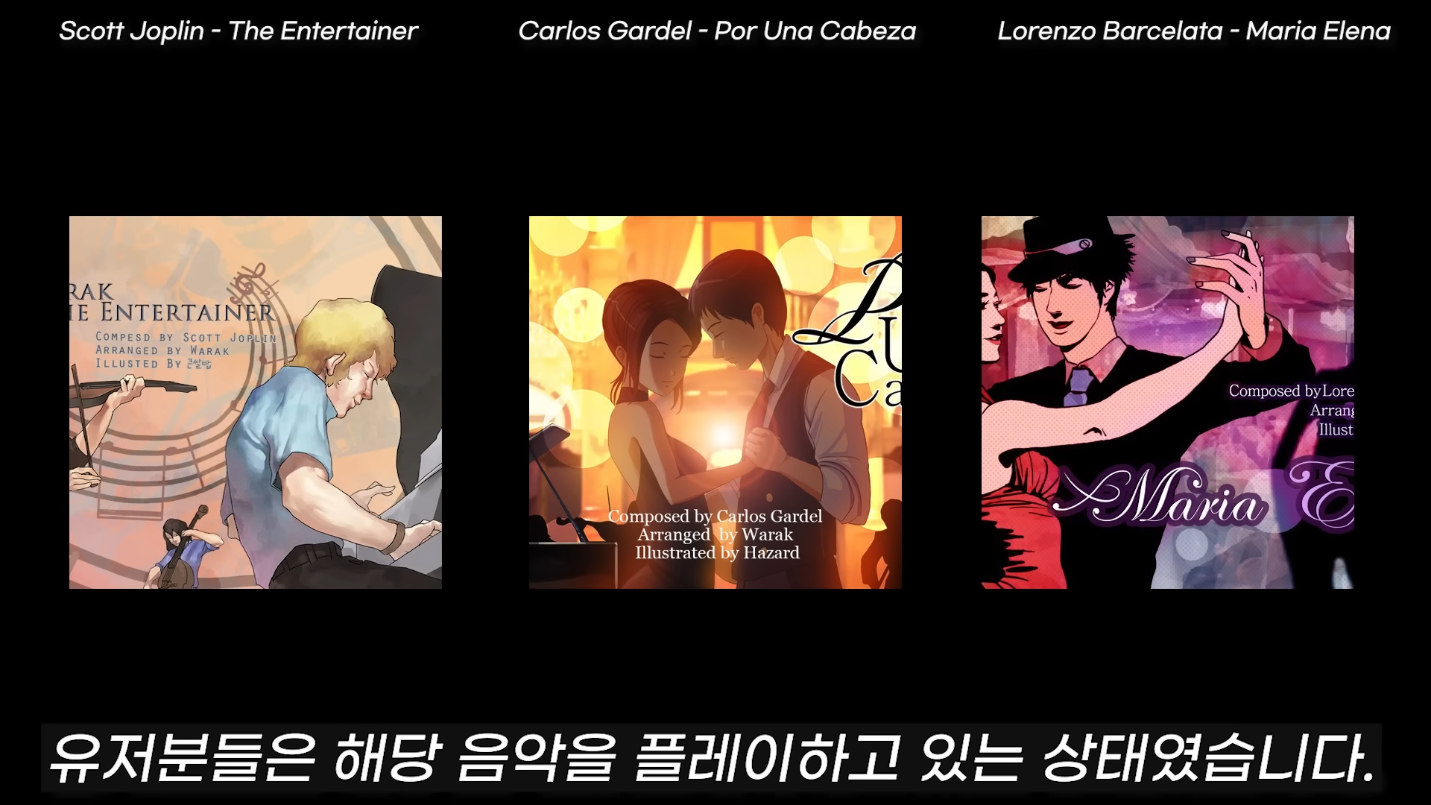
The Entertainer (Scott Joplin), Por Una Cabeza (Carlos Gardel), and Maria Elena (Lorenzo Barcelata) were chosen as trial pieces and subsequently released to the game with new arrangements by Warak.
 According to Warak, he afterwards received a call from a representative of Momo Media on behalf of representative director Jeong Sun-Kwon stating that Momo would like to pay half of the agreed upon commission fee due to the underperformance of these covers.
Warak says he rejected this request and felt offended that they would request this after the commissioned work was already received and implemented into the games.
According to the representative Jeong Sun-Kwon then countered with another proposal for Warak to submit a song for free as a make good for their longstanding relationship. This incensed Warak, he was offended that they would first claim his music was underperforming and not worth the agreed upon payment, and then proceed to ask for more music for free as “mends”.
In the video he produced retelling the lawsuits from his perspective, Warak makes an aside that often for video game music it is not necessary for the music to be enjoyable on its own when its main purpose is to fit the theme and setting of the game. But as someone who was busting his ass to make music that both fit the agreed upon specifications of the game and would stand up on its own, this treatment was especially upsetting and this would greatly hurt his confidence in his work that point forward.
Warak claims this incident left him emotionally distraught and depressed, causing a period of writer's block. He was afraid to seek medical treatment as he feared being medicated would forcefully stabilize his serotonin levels leaving him unable to properly access the emotional quality of his work. As a result there are no medical records to denote this period of distress.
According to Warak, he afterwards received a call from a representative of Momo Media on behalf of representative director Jeong Sun-Kwon stating that Momo would like to pay half of the agreed upon commission fee due to the underperformance of these covers.
Warak says he rejected this request and felt offended that they would request this after the commissioned work was already received and implemented into the games.
According to the representative Jeong Sun-Kwon then countered with another proposal for Warak to submit a song for free as a make good for their longstanding relationship. This incensed Warak, he was offended that they would first claim his music was underperforming and not worth the agreed upon payment, and then proceed to ask for more music for free as “mends”.
In the video he produced retelling the lawsuits from his perspective, Warak makes an aside that often for video game music it is not necessary for the music to be enjoyable on its own when its main purpose is to fit the theme and setting of the game. But as someone who was busting his ass to make music that both fit the agreed upon specifications of the game and would stand up on its own, this treatment was especially upsetting and this would greatly hurt his confidence in his work that point forward.
Warak claims this incident left him emotionally distraught and depressed, causing a period of writer's block. He was afraid to seek medical treatment as he feared being medicated would forcefully stabilize his serotonin levels leaving him unable to properly access the emotional quality of his work. As a result there are no medical records to denote this period of distress.
A note on who owns O2JAM
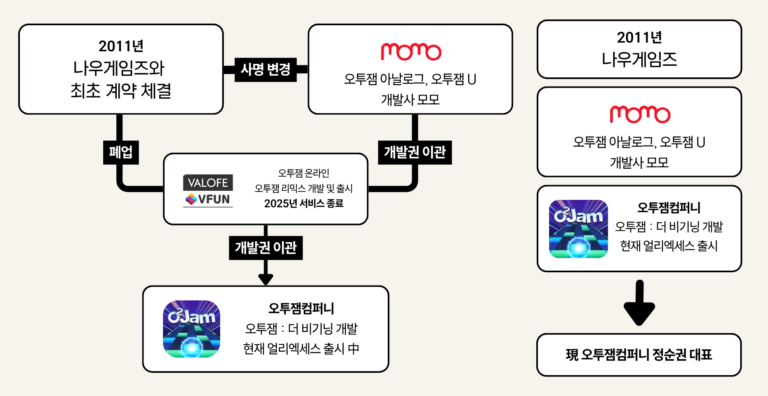 Now Games was already the third company the O2JAM property had been transferred to. O2Jam was first created by O2Media before shutting down and being transferred to NowCom in 2008. NowCom created the popular Korean video livestreaming service afreecaTV (now Soop) and in order to focus on its newfound success spun off its game development division into a subsidiary called Now Games in 2011. Now Games then went independent in 2012 and was renamed Momo Media. Momo Media then shuttered in 2017, and the rights to O2Jam were transferred to a newly formed O2Jam Company in 2019. O2Jam Company was dissolved in 2025 and the rights were transferred to the newly formed Musicturbine.
It should be noted that Now Games, Momo Media, O2Jam Company, and Musicturbine all share the same representative director, Jeong Sun-Kwon.
Now Games was already the third company the O2JAM property had been transferred to. O2Jam was first created by O2Media before shutting down and being transferred to NowCom in 2008. NowCom created the popular Korean video livestreaming service afreecaTV (now Soop) and in order to focus on its newfound success spun off its game development division into a subsidiary called Now Games in 2011. Now Games then went independent in 2012 and was renamed Momo Media. Momo Media then shuttered in 2017, and the rights to O2Jam were transferred to a newly formed O2Jam Company in 2019. O2Jam Company was dissolved in 2025 and the rights were transferred to the newly formed Musicturbine.
It should be noted that Now Games, Momo Media, O2Jam Company, and Musicturbine all share the same representative director, Jeong Sun-Kwon.
Discovering something amiss
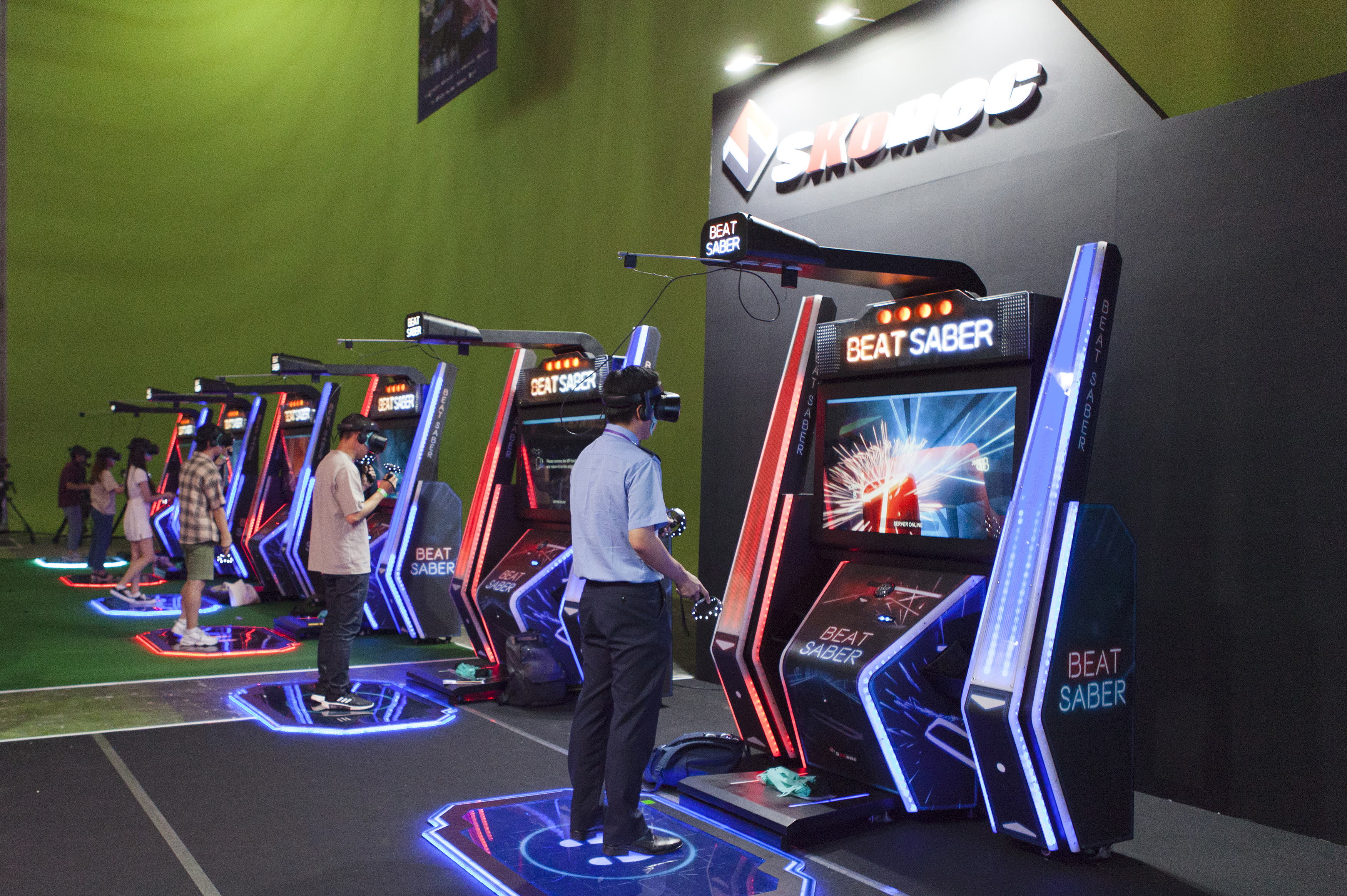 Years later in 2019, Warak noticed that his music was used in a Korean arcade adaptation of Beat Saber, produced by Skonec (Beat Saber Arcade would end service in 2020 as Beat Games stopped issuing commercial licenses for Beat Saber around the same time they started selling DLC with major label content). He was shocked as he did not sign a contract with Skonec, and soon discovered his music was licensed to the game and a dozen other games like Pump it Up, EZ2AC, and Tapsonic Bold by O2Jam Company.
The contract Warak signed in 2011 stipulated that he owns the copyright to the music provided to O2Jam and Now/Momo/O2 does not have the right to sublicense without his permission.
Despite this being a contractual violation, Warak didn't pursue legal action at first because he understood crosslicensing and “collaborations” were common amongst rhythm games and were popular with players so he tabled it.
The final straw was when he discovered O2Jam Company had registered his music in various audio fingerprinting programs like Youtube's ContentID and were receiving revenue from streaming services such as Youtube- something he states he did not pursue as he did not want to affect videos uploaded by O2JAM players on platforms such as Youtube. Not only was O2Jam Company making money off his work, they were making money in a way he specifically did not wish to do with O2JAM players in mind.
After having his copyright infringed and having previously been humiliated by Jeong Sun-Kwon, Warak was prepared to go to court against O2Jam to reassert his rights and obtain damages from Jeong Sun-Kwon personally.
Years later in 2019, Warak noticed that his music was used in a Korean arcade adaptation of Beat Saber, produced by Skonec (Beat Saber Arcade would end service in 2020 as Beat Games stopped issuing commercial licenses for Beat Saber around the same time they started selling DLC with major label content). He was shocked as he did not sign a contract with Skonec, and soon discovered his music was licensed to the game and a dozen other games like Pump it Up, EZ2AC, and Tapsonic Bold by O2Jam Company.
The contract Warak signed in 2011 stipulated that he owns the copyright to the music provided to O2Jam and Now/Momo/O2 does not have the right to sublicense without his permission.
Despite this being a contractual violation, Warak didn't pursue legal action at first because he understood crosslicensing and “collaborations” were common amongst rhythm games and were popular with players so he tabled it.
The final straw was when he discovered O2Jam Company had registered his music in various audio fingerprinting programs like Youtube's ContentID and were receiving revenue from streaming services such as Youtube- something he states he did not pursue as he did not want to affect videos uploaded by O2JAM players on platforms such as Youtube. Not only was O2Jam Company making money off his work, they were making money in a way he specifically did not wish to do with O2JAM players in mind.
After having his copyright infringed and having previously been humiliated by Jeong Sun-Kwon, Warak was prepared to go to court against O2Jam to reassert his rights and obtain damages from Jeong Sun-Kwon personally.
Suiting up
Before the lawsuit started in earnest, Warak and O2Jam Company entered mediation (or arbitration) in an attempt to bring both parties into a mutual understanding of the affair. But this was also a poor experience as Jeong Sun-Kwon clammed up and asserted as the commissioning entity it's fair that he share rights to the resulting work.
The arbitration findings were unsatisfactory, the mediator ruled that O2Jam must pay damages to Warak and in turn Warak would drop the suit. Warak intended to cancel the contract and return all rights back to him so he proceeded with the suit.
The first trial dragged on for two years due to the COVID-19 pandemic but eventually it was ruled that as O2Jam Company was a separate party not included in the initial contract with Now Games (which was now dissolved), they did not have the right to use any of Warak's music. However just because Jeong Sun-Kwon was the representative director of both companies did not make him personally liable for damages.
In his video summarizing the lawsuits, Warak noted that he was inexperienced and the first lawyer he hired did not adequately advise him during this first suit and he was left to do much of the discovery himself, even having to personally contact Sandbox Network (the digital music distributor used by Momo/O2) to request revenue data and contract documents.
 Han Jeong-hyeon, the CEO EPID Games, a Korean game development studio known for the mobile games TrickCal and Paint Heroes which Warak wrote music for, introduced Warak to a second lawyer, Kim Seon-wook of the law firm Haemaru who advised on dismissing the first case and filing a second suit expanding the amount of damages based on lost revenue from licensing and streaming revenue.
Unfortunately Warak lost the second case on the grounds of the commissioning contract being referred to as a “매절이라는 “, or a buyout, or lump sum contract. The appellate court took this to imply that the copyright is transferred for a set fee and this designation trumps any language within the contract in reference to rights ownership.
Warak appealed this decision up to the Supreme Court despite knowing the chances of this ruling being overturned was slim, and they ultimately ruled this is a poor interpretation of “매절이라는 “. In some fields such as character illustrations, a 매절이라는 contract is commonly agreed to involve a transfer of copyright in exchange for a flat fee but really the term just refers to how the laborer is paid by the client and doesn't necessarily imply any transfer of copyright unless it an established tradition in the trade. Video game music on the other hand has a variety of use rights, including for soundtrack release, use in-game, public performance, etc, which are separate and negotiated case-by-case. So the fact that there was explicit language prohibiting the sublicensing of rights in the contract should've trumped any “layman understanding” of the term “매절이라는”.
Han Jeong-hyeon, the CEO EPID Games, a Korean game development studio known for the mobile games TrickCal and Paint Heroes which Warak wrote music for, introduced Warak to a second lawyer, Kim Seon-wook of the law firm Haemaru who advised on dismissing the first case and filing a second suit expanding the amount of damages based on lost revenue from licensing and streaming revenue.
Unfortunately Warak lost the second case on the grounds of the commissioning contract being referred to as a “매절이라는 “, or a buyout, or lump sum contract. The appellate court took this to imply that the copyright is transferred for a set fee and this designation trumps any language within the contract in reference to rights ownership.
Warak appealed this decision up to the Supreme Court despite knowing the chances of this ruling being overturned was slim, and they ultimately ruled this is a poor interpretation of “매절이라는 “. In some fields such as character illustrations, a 매절이라는 contract is commonly agreed to involve a transfer of copyright in exchange for a flat fee but really the term just refers to how the laborer is paid by the client and doesn't necessarily imply any transfer of copyright unless it an established tradition in the trade. Video game music on the other hand has a variety of use rights, including for soundtrack release, use in-game, public performance, etc, which are separate and negotiated case-by-case. So the fact that there was explicit language prohibiting the sublicensing of rights in the contract should've trumped any “layman understanding” of the term “매절이라는”.
Setting an example in the industry
In recorded music, rights are often structured in terms of rights to the recording and rights to the composition. A record label may own the rights to the recording but the artist usually retains the rights to the composition and beyond any flat rate paid for the recording they are paid residuals for the rights to the composition in any sale or licensing agreement for the recording.
This is not tradition in rhythm games. Often songs are works for hire, and after paying a flat fee, a client company will assume ownership of the entire intellectual property of a song. This makes business dealings such as sublicensing to other games much easier for the client party but it also means artists are left out of the success of their own work, unable to earn residuals if their music blows up in popularity.
It often also means an artist is unable to get any additional revenue from other uses of the song such as performances or music sales. This has slowly changed as companies such as SEGA offer license-back deals that allow artists to offer their commissioned works on digital music platforms but there are still companies like KONAMI and Musicturbine which either offer onerous terms that limit the ways artists can use their works for hire or will exploit other uses themselves by registering them on audio fingerprinting programs and digital music platforms.
 Warak is of course an outlier, his contract stipulated he retained the rights to his work. But how many other artists are out there with contracts similar to Warak but are afraid to speak about how their rights are being violated?
In his video, Warak hopes that his suit sets and example and encourages artists to assert their rights both in contract negotiations and legal proceedings. He stresses that these lawsuits were not about the money, and indeed he states that personally contacted every studio that previously licensed works he produced for O2Jam to assure them they would not be parties in any legal proceedures and he was not perusing any company other than O2/Musicturbine for damages.
He ended his video on an anecdote that he rerecorded and reproduced the track “Shining” for PLATiNA::LAB on his own dime despite the game only paying for a license to the original 2006 recording as a sign of gratitude for entering licensing agreements with him while the cases were ongoing and it was still ambiguous if he had the copyright to his work.
He also states unambiguously that the use of his work in the recent Steam rerelease of O2Jam: The Beginning was unauthorized and they had no right to do so.
The story is still not over, there is still one more case left to determine damages and remedies, I'll be sure to be back again to write more once that happens.
Warak is of course an outlier, his contract stipulated he retained the rights to his work. But how many other artists are out there with contracts similar to Warak but are afraid to speak about how their rights are being violated?
In his video, Warak hopes that his suit sets and example and encourages artists to assert their rights both in contract negotiations and legal proceedings. He stresses that these lawsuits were not about the money, and indeed he states that personally contacted every studio that previously licensed works he produced for O2Jam to assure them they would not be parties in any legal proceedures and he was not perusing any company other than O2/Musicturbine for damages.
He ended his video on an anecdote that he rerecorded and reproduced the track “Shining” for PLATiNA::LAB on his own dime despite the game only paying for a license to the original 2006 recording as a sign of gratitude for entering licensing agreements with him while the cases were ongoing and it was still ambiguous if he had the copyright to his work.
He also states unambiguously that the use of his work in the recent Steam rerelease of O2Jam: The Beginning was unauthorized and they had no right to do so.
The story is still not over, there is still one more case left to determine damages and remedies, I'll be sure to be back again to write more once that happens.
 Oh I guess that brings me to the unions.
%20-%20MangaDex.png) Honey Come Chatka's peak popularity on Mangadex was sirlorence's first upload at ~1500 views and immediately went off a cliff to the ~250-700 range.
Honey Come Chatka's peak popularity on Mangadex was sirlorence's first upload at ~1500 views and immediately went off a cliff to the ~250-700 range.
%20-%20MangaDex.png) And this is true across the board. Friends will know I've become obsessed with Mousou Telepathy and have started reading her first series, My Alien Days. Both are scanlated by Helvetica Scans and while Mousou readership has grown to 25k views per page, MAD peaked at its first chapter of 14k views and dropped to the 400 range since reaching the post-paperback publication chapters.
And this is true across the board. Friends will know I've become obsessed with Mousou Telepathy and have started reading her first series, My Alien Days. Both are scanlated by Helvetica Scans and while Mousou readership has grown to 25k views per page, MAD peaked at its first chapter of 14k views and dropped to the 400 range since reaching the post-paperback publication chapters.
%20-%20MangaDex.png)
 Really, ain't this true of all art in general? The sophomore slump, the one hit wonder, the viral hit. We're conditioned to think that when we find success, it is because others are attracted to our vision, when that's really not true at all. It feels more correct to say that we are used as vessels to bring different concepts and ideas to life, and they have a life outside of our own. The only problem is art doesn't need a salary to maintain life, but artists do.
Really, ain't this true of all art in general? The sophomore slump, the one hit wonder, the viral hit. We're conditioned to think that when we find success, it is because others are attracted to our vision, when that's really not true at all. It feels more correct to say that we are used as vessels to bring different concepts and ideas to life, and they have a life outside of our own. The only problem is art doesn't need a salary to maintain life, but artists do.